




 English
 Translate
LILYGO T-Radar
🚀 Product Overview
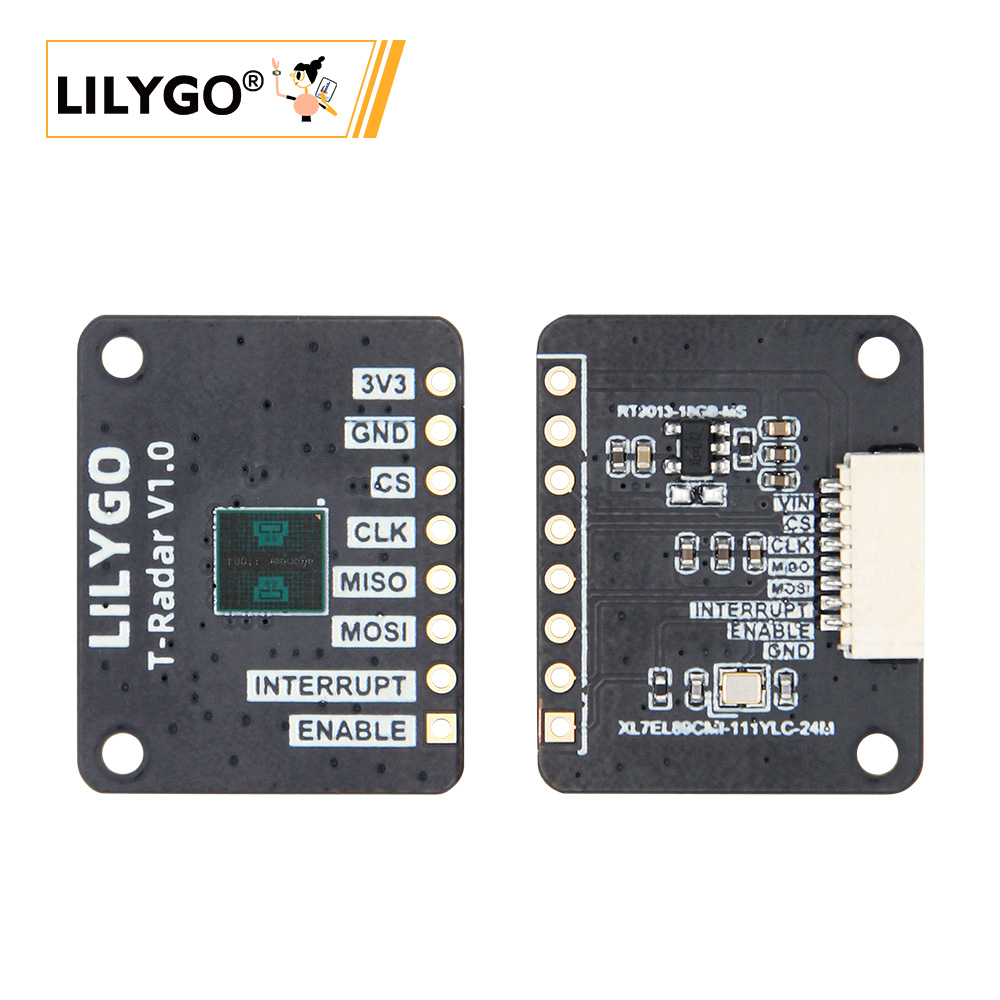
LILYGO T‑Radar V1.0 is a high-precision proximity detection expansion board based on the 60GHz A121 radar chip. It utilizes Pulsed Coherent Radar (PCR) technology, enabling distance measurement up to 20 meters, with millimeter-level absolute accuracy and micrometer-level relative accuracy. It is suitable for various applications such as high-precision motion sensing, material identification, object tracking, and vital sign detection.
Core Features
- ✅ High-Precision Ranging: Absolute accuracy at millimeter level, relative accuracy at micrometer level.
- ✅ Long-Range Detection: Maximum measurement range of 20 meters.
- ✅ Multi-Functional Radar: Supports motion detection, material classification, object tracking, breathing, and heart rate monitoring.
- ✅ Plug and Play: Compatible with various LILYGO mainboards (requires sufficient external I/O).
- ✅ Industrial-Grade Design: Suitable for scientific research, medical, sports, and engineering measurements.
📊 Technical Specifications
| Item | Parameter |
|---|---|
| Radar Chip | A121 60GHz Pulsed Coherent Radar (PCR) |
| Maximum Measurement Distance | 20 meters |
| Absolute Accuracy | Millimeter level (mm) |
| Relative Accuracy | Micrometer level (µm) |
| Interface Type | Standard expansion board interface |
| Power Supply Voltage | 3.3V / 5V (depending on the mainboard) |
| Communication Interface | I²C / SPI (configurable via jumpers) |
| Application Scenarios | Motion sensing, material identification, engineering measurement, medical detection |
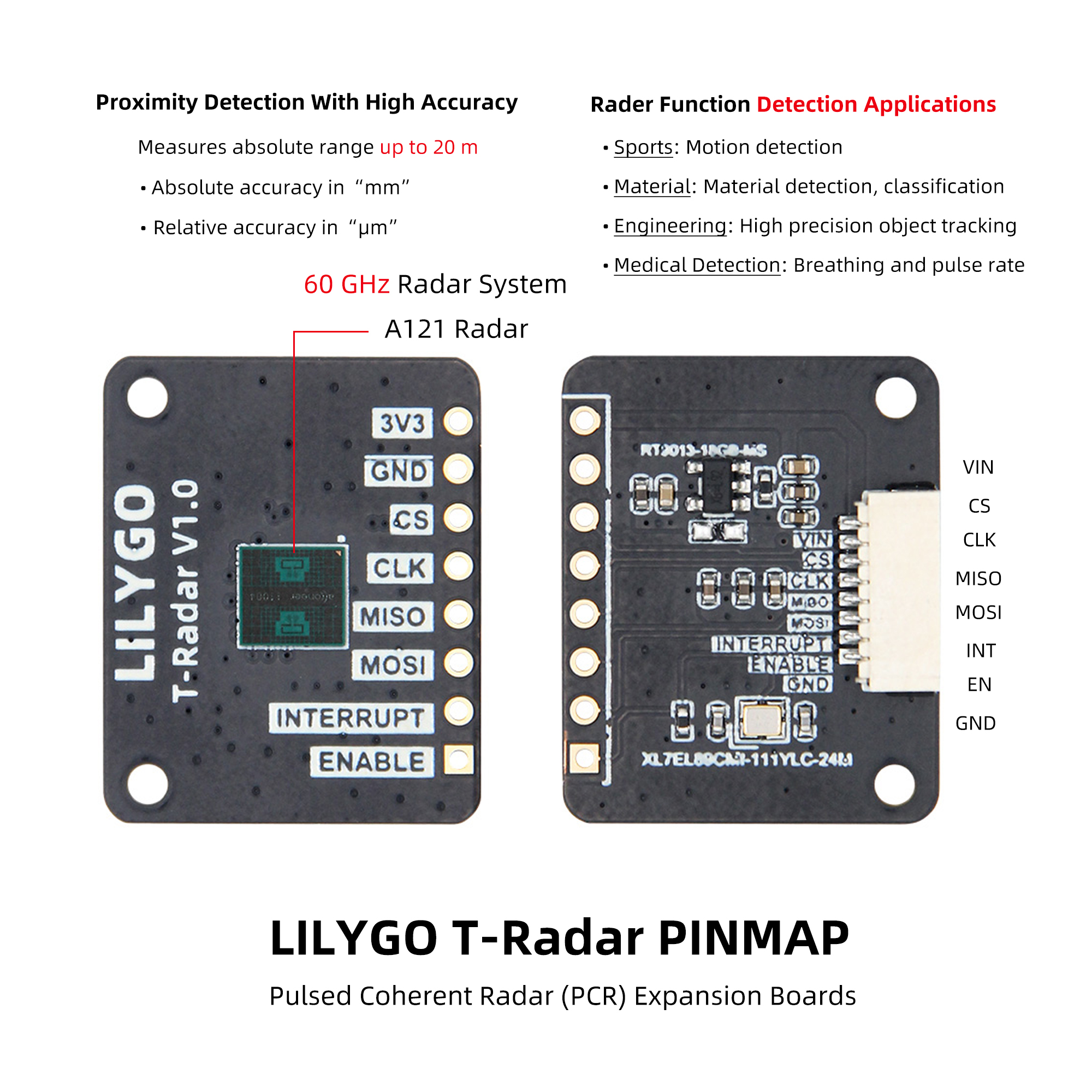
Pinout Diagram
Kit Contents
- T‑Radar V1.0 Expansion Board ×1
- Pin Headers (optional for soldering) ×1 set
- Screws and Mounting Accessories ×1 set
- Quick Start Guide ×1
🛠️ Installation and Usage
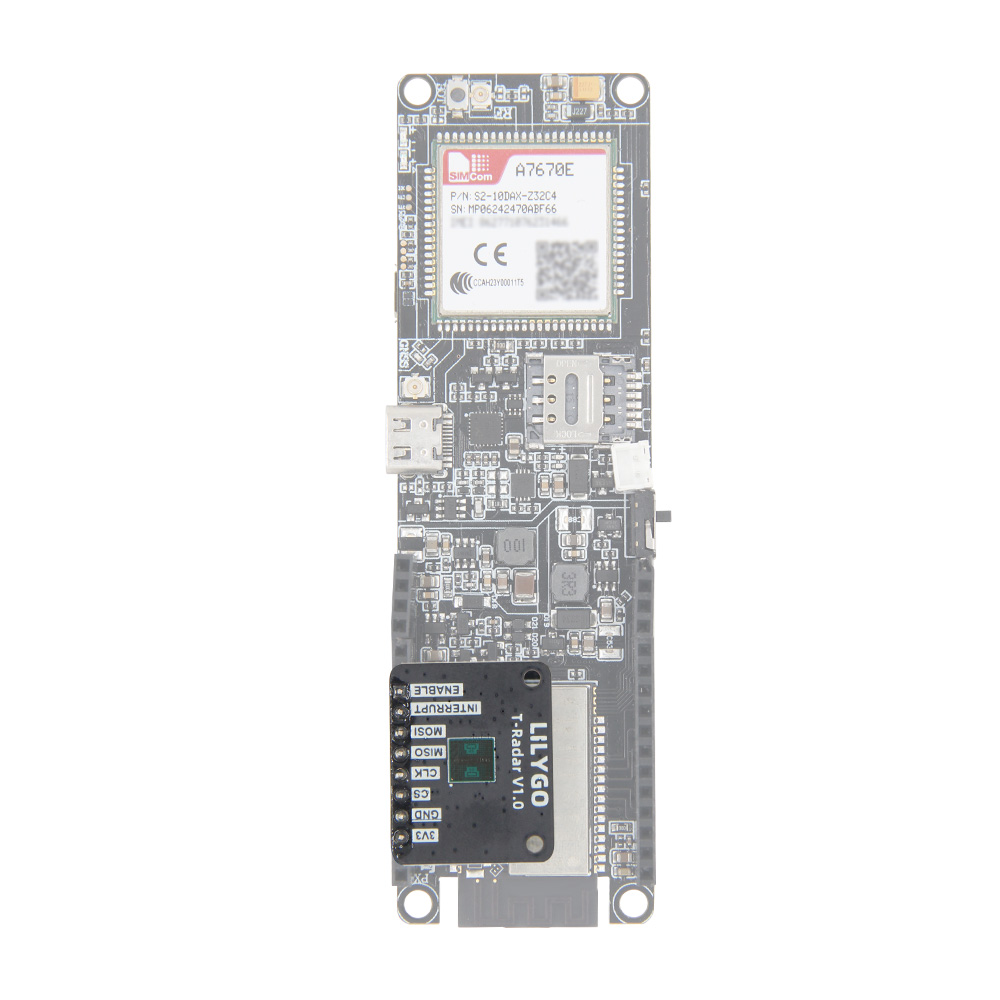
Connection Diagram
Usage Steps
Hardware Connection
- Connect the T‑Radar to a compatible LILYGO mainboard (e.g., T3, T‑Beam, etc.) via the pin headers.
- Ensure the mainboard provides sufficient I/O and power (3.3V/5V).
Software Configuration
- Download and install the radar driver library.
- Initialize the radar module via I²C or SPI interface.
- Configure measurement modes (distance, motion, vital signs, etc.).
Data Acquisition
- Read radar data such as distance, speed, or vital signs.
- Perform data filtering and algorithm processing as needed.
🧭 Application Scenarios
🏃 Sports and Athletics
- Athlete motion capture and analysis.
- Fitness equipment motion trajectory tracking.
🧱 Materials and Industry
- Material classification and identification.
- Surface deformation detection.
⚙️ Engineering and Measurement
- High-precision object distance tracking.
- Mechanical equipment vibration monitoring.
🏥 Medical and Health
- Non-contact breathing detection.
- Heart rate monitoring (at rest).
🏠 Smart Home and IoT
- Human presence detection.
- Gesture recognition for interaction.
❓ Frequently Asked Questions
Q1: Can T‑Radar be used outdoors?
A: Yes, 60GHz radar is less affected by weather, but heavy rain or snow may cause slight signal attenuation.
Q2: Does it support multi-target detection?
A: The current version is mainly designed for single-target high-precision ranging and tracking. Multi-target identification requires additional algorithm processing.
Q3: What is the maximum refresh rate?
A: It depends on the main controller chip and communication interface. Typically, it supports data update rates above 100Hz.
Q4: Can it detect objects behind glass or walls?
A: The radar can penetrate thin non-metallic layers, but metallic materials will completely block the signal.