claude-desktop-buddy
Claude for macOS and Windows can connect Claude Cowork and Claude Code to maker devices over BLE, so developers and makers can build hardware that displays permission prompts, recent messages, and other interactions. We've been impressed by the creativity of the maker community around Claude - providing a lightweight, opt-in API is our way of making it easier to build fun little hardware devices that integrate with Claude.
Building your own device? You don't need any of the code here. See REFERENCE.md for the wire protocol: Nordic UART Service UUIDs, JSON schemas, and the folder push transport.
As an example, we built a desk pet on ESP32 that lives off permission approvals and interaction with Claude. It sleeps when nothing's happening, wakes when sessions start, gets visibly impatient when an approval prompt is waiting, and lets you approve or deny right from the device.
Hardware
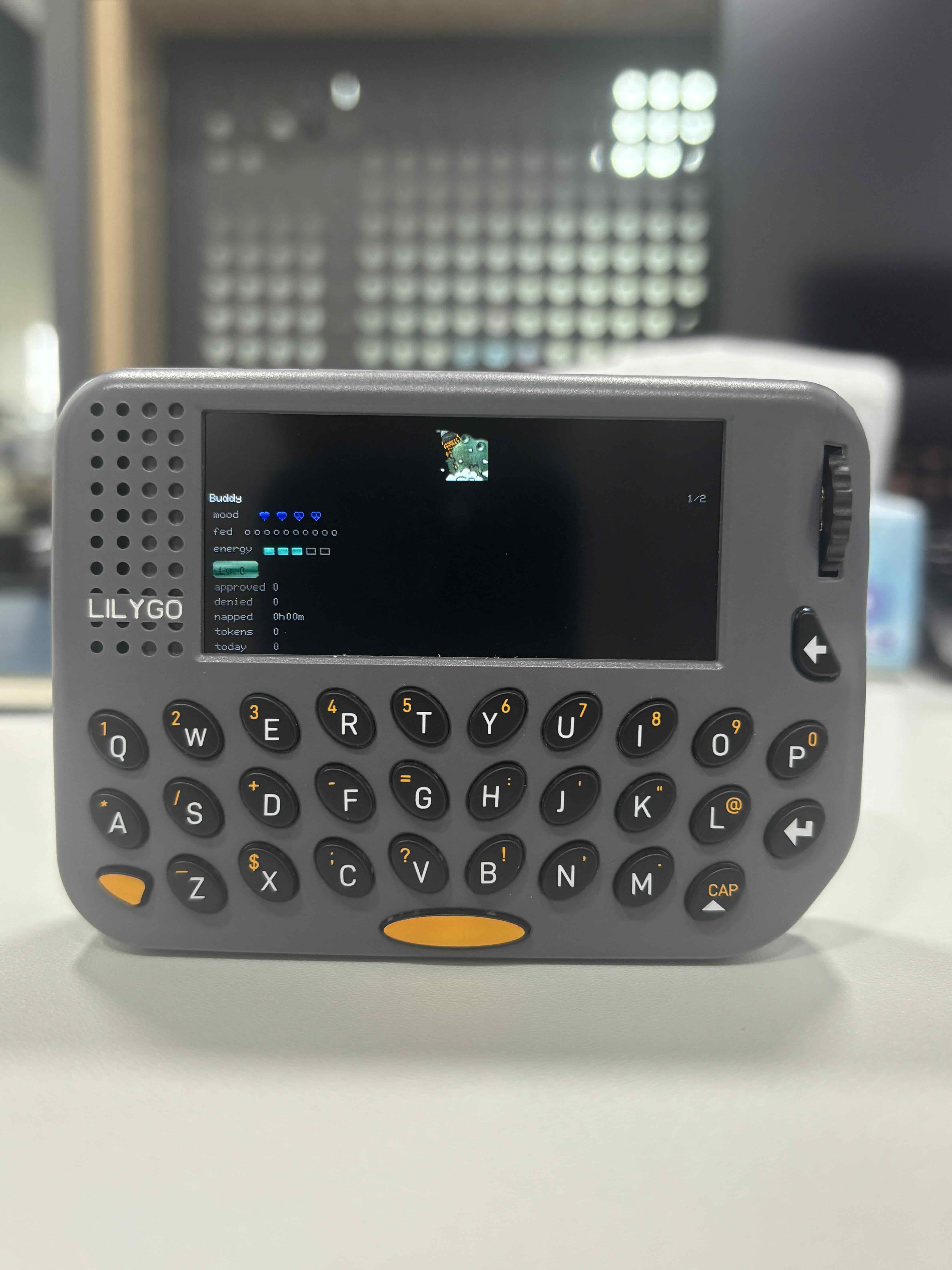
The firmware targets the LILYGO T-Lora pager (ESP32-S3 + LoRa). It uses the LilyGoLib library for display, IMU, and peripheral drivers.
Flashing
ESP32 烧录工具 (官方API)
选择固件
操作日志
Pairing
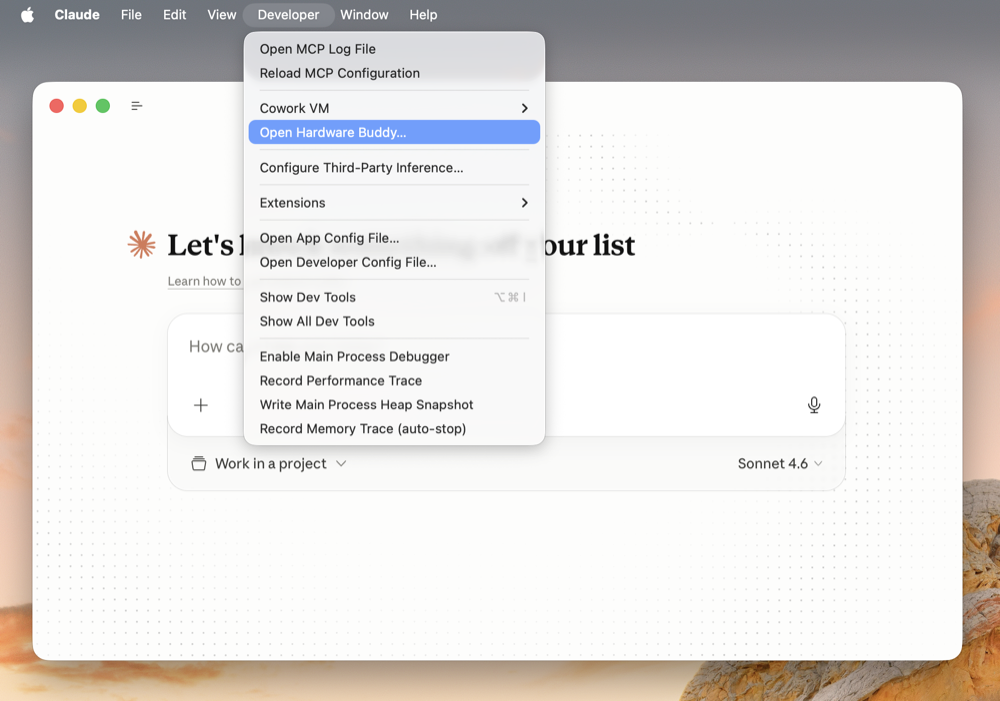
To pair your device with Claude, first enable developer mode (Help → Troubleshooting → Enable Developer Mode). Then, open the Hardware Buddy window in Developer → Open Hardware Buddy…, click Connect, and pick your device from the list. macOS will prompt for Bluetooth permission on first connect; grant it.
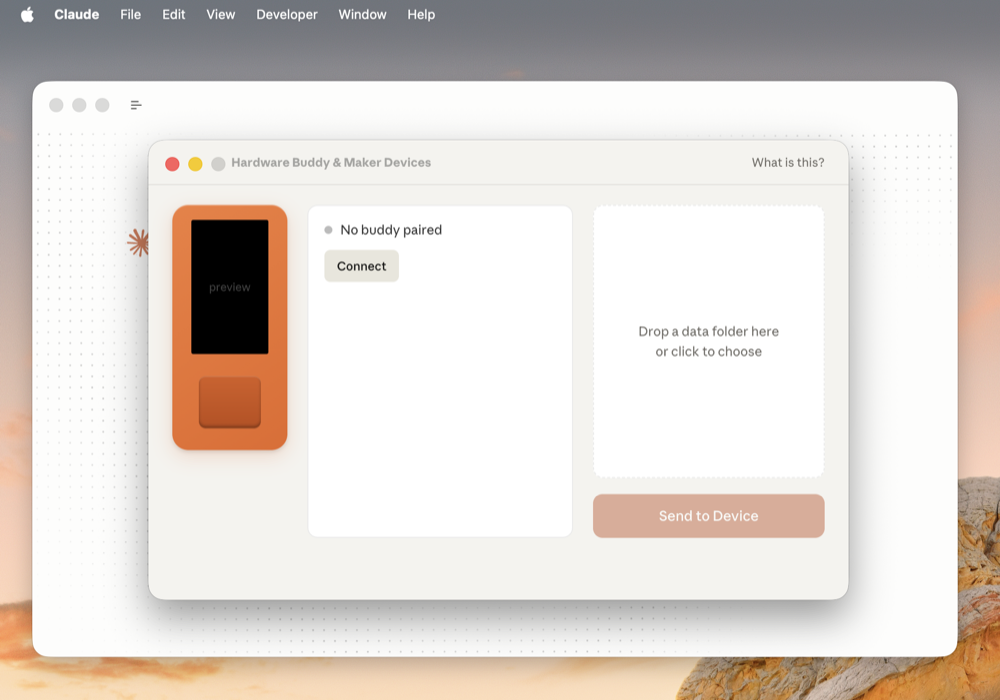
Once paired, the bridge auto-reconnects whenever both sides are awake.
If discovery isn't finding the pager:
- Make sure it's awake (any button press)
- Check the pager's settings menu → bluetooth is on
Controls
The pager has three controls: a Center button (rotary click, top right), a Rotary encoder (scroll wheel, top right), and a Boot button (bottom side).
| Normal | Pet | Info | Approval | |
|---|---|---|---|---|
| Center (single) | next screen | next screen | next screen | approve |
| Center (double) | screen off/on | screen off/on | screen off/on | — |
| Hold Center (~1s) | menu | menu | menu | menu |
| Rotary | scroll transcript | next page | next page | — |
| Boot (single) | — | — | — | deny |
| Boot (~6s) | deep sleep | |||
| Shake | dizzy | — | ||
| Face-down | nap (energy refills) |
The screen auto-powers-off after 30s of no interaction (kept on while an approval prompt is up). Any button press wakes it.
ASCII pets
Eighteen pets, each with seven animations (sleep, idle, busy, attention, celebrate, dizzy, heart). Menu → "next pet" cycles them with a counter. Choice persists to NVS.
GIF pets
If you want a custom GIF character instead of an ASCII buddy, drag a character pack folder onto the drop target in the Hardware Buddy window. The app streams it over BLE and the pager switches to GIF mode live. Settings → delete char reverts to ASCII mode.
A character pack is a folder with manifest.json and 96px-wide GIFs:
{
  "name": "bufo",
  "colors": {
    "body": "#6B8E23",
    "bg": "#000000",
    "text": "#FFFFFF",
    "textDim": "#808080",
    "ink": "#000000"
  },
  "states": {
    "sleep": "sleep.gif",
    "idle": ["idle_0.gif", "idle_1.gif", "idle_2.gif"],
    "busy": "busy.gif",
    "attention": "attention.gif",
    "celebrate": "celebrate.gif",
    "dizzy": "dizzy.gif",
    "heart": "heart.gif"
  }
}
State values can be a single filename or an array. Arrays rotate: each loop-end advances to the next GIF, useful for an idle activity carousel so the home screen doesn't loop one clip forever.
GIFs are 96px wide; height up to ~140px stays on a 135×240 portrait screen. Crop tight to the character — transparent margins waste screen and shrink the sprite. tools/prep_character.py handles the resize: feed it source GIFs at any sizes and it produces a 96px-wide set where the character is the same scale in every state.
The whole folder must fit under 1.8MB — gifsicle --lossy=80 -O3 --colors 64 typically cuts 40–60%.
See characters/bufo/ for a working example.
If you're iterating on a character and would rather skip the BLE round-trip, tools/flash_character.py characters/bufo stages it into data/ and runs pio run -t uploadfs directly over USB.
The seven states
| State | Trigger | Feel |
|---|---|---|
sleep | bridge not connected | eyes closed, slow breathing |
idle | connected, nothing urgent | blinking, looking around |
busy | sessions actively running | sweating, working |
attention | approval pending | alert, LED blinks |
celebrate | level up (every 50K tokens) | confetti, bouncing |
dizzy | you shook the pager | spiral eyes, wobbling |
heart | approved in under 5s | floating hearts |
Project layout
src/
  main.cpp       — loop, state machine, UI screens
  buddy.cpp      — ASCII species dispatch + render helpers
  buddies/       — one file per species, seven anim functions each
  ble_bridge.cpp — Nordic UART service, line-buffered TX/RX
  character.cpp  — GIF decode + render
  data.h         — wire protocol, JSON parse
  xfer.h         — folder push receiver
  stats.h        — NVS-backed stats, settings, owner, species choice
characters/      — example GIF character packs
tools/           — generators and converters
Availability
The BLE API is only available when the desktop apps are in developer mode (Help → Troubleshooting → Enable Developer Mode). It's intended for makers and developers and isn't an officially supported product feature.