T3-S3 MVSR Board get it now
Overview
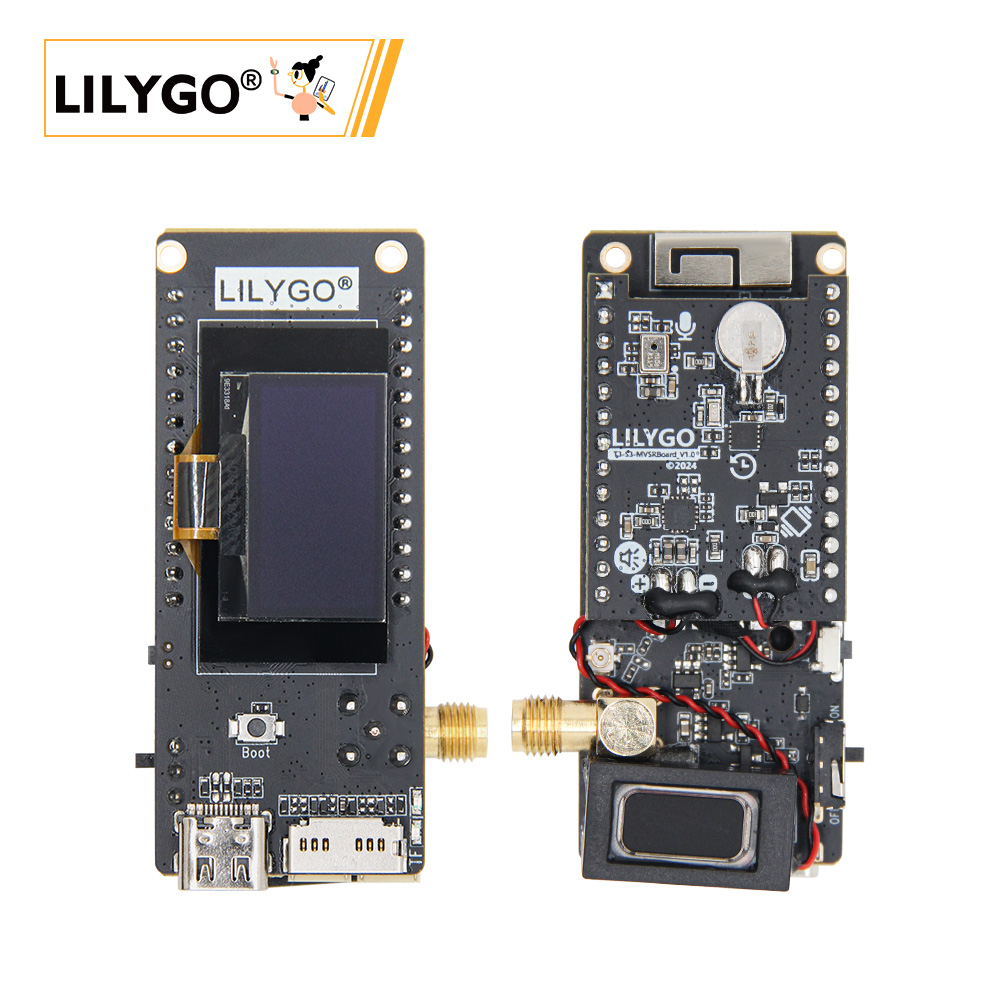
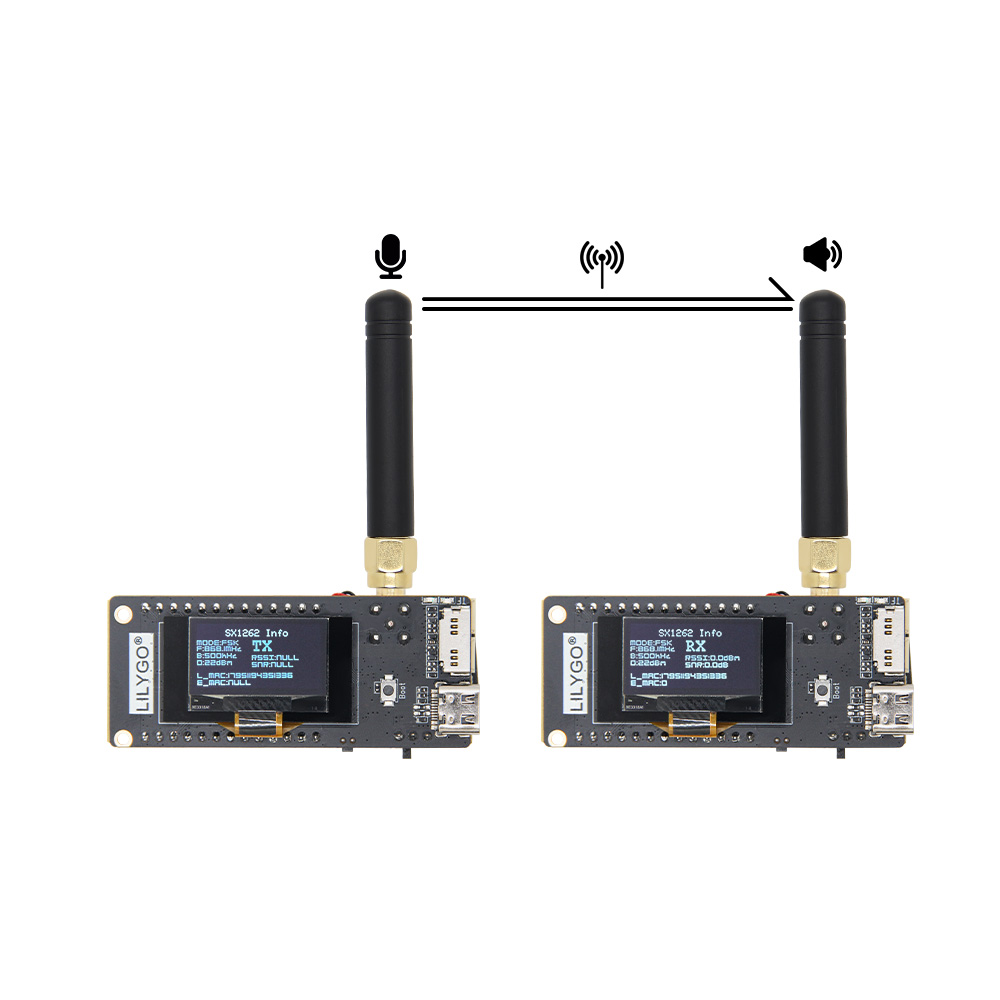
The T3-S3 MVSR Board is an expansion baseboard for the T3-S3 V1.2 main board, adding vibration motor, microphone (I2S/PDM), speaker (MAX98357A I2S), and RTC (PCF85063ATL) functions. Its primary use case is LoRa voice transmission: the SX1262 version uses FSK modulation; the SX1280 version uses LoRa modulation. It can also be used for AI voice interaction, MP3 playback, and other audio applications. Features extremely low static current (2.77 µA deep sleep).
Quick Start
Example Support
| Example | PlatformIO/Arduino | ESP-IDF | Description |
|---|---|---|---|
| T3-S3-MVSRBoard | ✓ | Audio, LoRa voice, RTC, vibration, SD examples |
Available examples
| Example | Description |
|---|---|
| DMIC_ReadData | Digital microphone read |
| DMIC_SD | Microphone → SD card recording |
| Original_Test | Factory test |
| PCF85063 | RTC read/write |
| SD_Music | Play MP3 from SD card |
| Sleep_Wake_Up | Deep sleep & wake |
| SX126x_Walkie_Talkie | LoRa voice intercom |
| Voice_Speaker | Voice → speaker |
| Vibration_Motor | Vibration motor control |
PlatformIO
- Install Visual Studio Code and Python
- Search for and install the PlatformIO IDE extension in VS Code
- Open the
T3-S3-MVSRBoardproject folder - Open
platformio.ini, under[platformio]→default_envsuncomment the example to flash - Click ✓ to compile, connect via USB-C, click → to upload
Arduino
- Install Arduino IDE
- In Tools → Board Manager, search for
esp32and install esp32 by Espressif Systems - Copy library folders from the project
librariesdirectory to your Arduino Sketchbook libraries folder - Open the example
.inofile from theexamplesdirectory - In Tools → Board, configure:
| Arduino IDE Setting | Value |
|---|---|
| Board | ESP32S3 Dev Module |
| Upload Speed | 921600 |
| USB Mode | Hardware CDC and JTAG |
| USB CDC On Boot | Enabled |
| USB Firmware MSC On Boot | Disabled |
| USB DFU On Boot | Disabled |
| CPU Frequency | 240 MHz (WiFi) |
| Flash Mode | QIO 80 MHz |
| Flash Size | 16MB (128Mb) |
| Core Debug Level | None |
| Partition Scheme | 16M Flash (3MB APP/9.9MB FATFS) |
| PSRAM | OPI PSRAM |
| Arduino Runs On | Core 1 |
| Events Run On | Core 1 |
- Select the correct port and click Upload
If upload fails: hold BOOT, press RST, release RST, then click Upload.
Development Platforms
Video
Key Features
- ESP32-S3FH4R2 dual-core LX7 @ 240 MHz, Wi-Fi + Bluetooth 5.0
- SX1262 (868/915 MHz, FSK) or SX1280 (2.4 GHz, LoRa) — matches T3-S3 main board
- MAX98357A I2S speaker amplifier (9 dB gain default)
- Microphone: MSM261S4030H0R I2S (V1.0) / MP34DT05-A PDM (V1.1)
- PCF85063ATL Real-time Clock (I2C)
- Haptic vibration motor
- TF card slot for storage expansion
- Deep sleep current: 2.77 µA
Product Parameters
| Feature | Specification |
|---|---|
| MCU | ESP32-S3FH4R2 @ Dual-core LX7, 240 MHz |
| Flash | 4 MB |
| PSRAM | 2 MB (OPI PSRAM) |
| Wi-Fi | 2.4 GHz 802.11 b/g/n |
| Bluetooth | Bluetooth 5.0 |
| LoRa | SX1262 (868/915 MHz) or SX1280 (2.4 GHz) |
| Speaker | MAX98357A (I2S) |
| Microphone V1.0 | MSM261S4030H0R (I2S) |
| Microphone V1.1 | MP34DT05-A (PDM) |
| RTC | PCF85063ATL (I2C) |
| Vibration | Haptic motor |
| Storage | TF card slot |
| USB | 1 × Type-C |
| Power Input | 5 V / 500 mA |
| Mounting Holes | 2 × M2 |
| Dimensions | 66 × 27 × 15 mm |
Pin Diagram
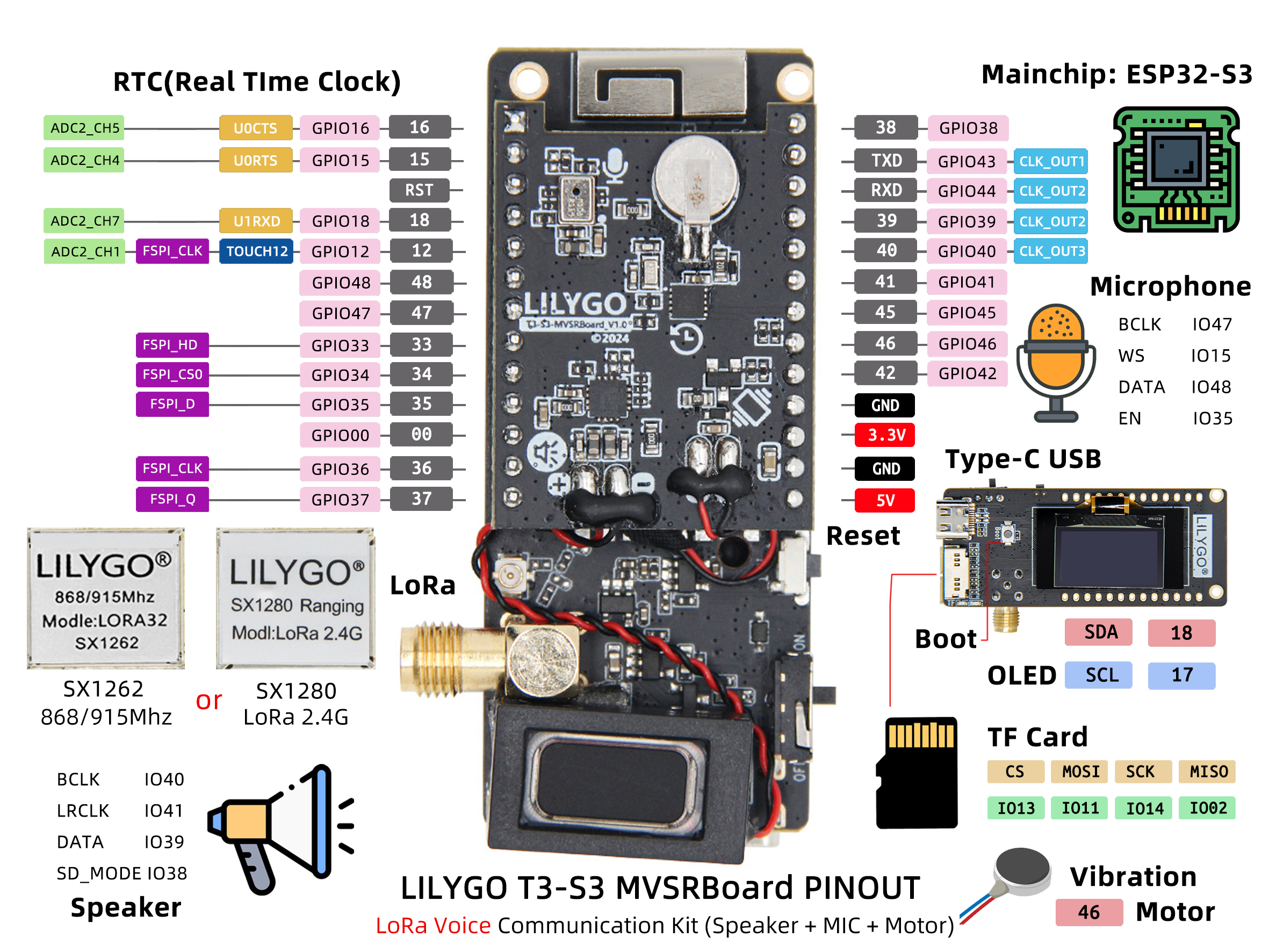
Speaker (MAX98357A)
| Signal | GPIO |
|---|---|
| BCLK | 40 |
| LRCLK | 41 |
| DATA | 39 |
| SD_MODE | 38 |
Microphone — V1.0 (MSM261S4030H0R, I2S)
| Signal | GPIO |
|---|---|
| BCLK | 47 |
| WS | 15 |
| DATA | 48 |
| EN | 35 |
Microphone — V1.1 (MP34DT05-A, PDM)
| Signal | GPIO |
|---|---|
| LRCLK | 15 |
| DATA | 48 |
| EN | 35 |
Vibration Motor
| Signal | GPIO |
|---|---|
| DATA | 46 |
RTC (PCF85063ATL)
| Signal | GPIO |
|---|---|
| SDA | 42 |
| SCL | 45 |
| INT | 16 |
SX126x (SX1262)
| Signal | GPIO |
|---|---|
| CS | 7 |
| RST | 8 |
| SCLK | 5 |
| MOSI | 6 |
| MISO | 3 |
| DIO1 | 33 |
| BUSY | 34 |
SX127x
| Signal | GPIO |
|---|---|
| CS | 7 |
| RST | 8 |
| SCLK | 5 |
| MOSI | 6 |
| MISO | 3 |
| DIO0 | 9 |
| DIO1 | 33 |
| DIO2 | 34 |
| DIO3 | 21 |
| DIO4 | 10 |
| DIO5 | 36 |
SX128x (SX1280)
| Signal | GPIO |
|---|---|
| CS | 7 |
| RST | 8 |
| SCLK | 5 |
| MOSI | 6 |
| MISO | 3 |
| DIO1 | 9 |
| BUSY | 36 |
| TX | 10 |
| RX | 21 |
Dimension Diagram
Schematic
Datasheet
- MAX98357A Datasheet
- MP34DT05-A Datasheet
- MSM261S4030H0R Datasheet
- PCF85063ATL Datasheet
- ESP32-S3 Datasheet
Software Development
Dependent Libraries
FAQ
Q. How to adjust the external antenna resistor? A. Refer to the image below for resistor direction adjustment:
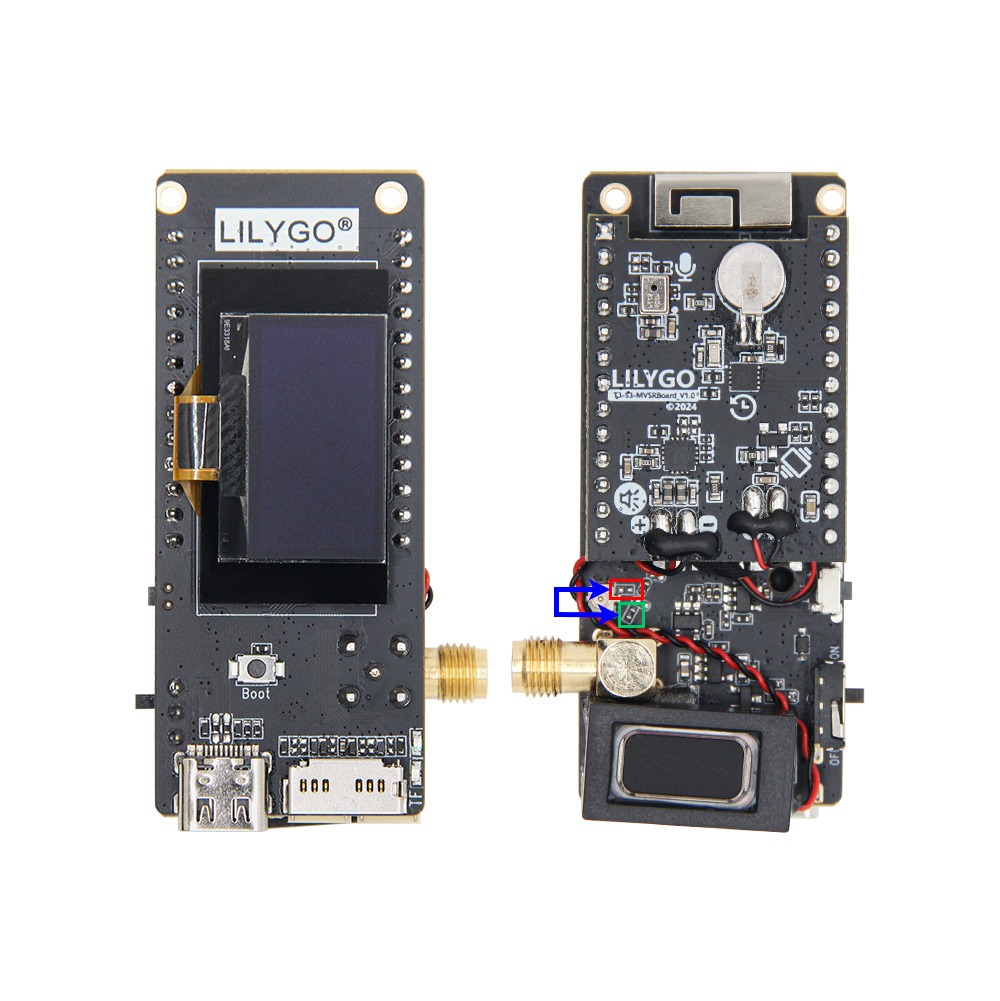
Q. What's the difference between SX1262 and SX1280 versions? A. SX1262 supports 868/915 MHz using FSK modulation; SX1280 supports 2.4 GHz using LoRa modulation.
Q. Which audio formats are supported? A. Supports WAV, MP3, and other common audio formats (with software decoding libraries).
Q. What is the LoRa voice communication range? A. Under ideal conditions, voice communication range can reach several kilometers, depending on environment and antenna.
Q. Does it support real-time voice transmission? A. Yes — supports real-time voice acquisition, compression, and LoRa transmission for walkie-talkie functionality.
Version History
| Version | Release Date | Update Description |
|---|---|---|
| T3-S3-MVSRBoard_V1.0 | 2024-11-06 | Initial version |
| T3-S3-MVSRBoard_V1.1 | 2025-03-18 | Changed microphone to MP34DT05-A (PDM) |
Related Tests
Power Consumption
| Mode | Minimum Current |
|---|---|
| Deep Sleep | 2.77 µA |
Audio Performance
| Parameter | Specification |
|---|---|
| Sample Rate | 8–48 kHz |
| Bit Depth | 16-bit |
| Signal-to-Noise Ratio | >90 dB |