
T3-TCXO
Overview
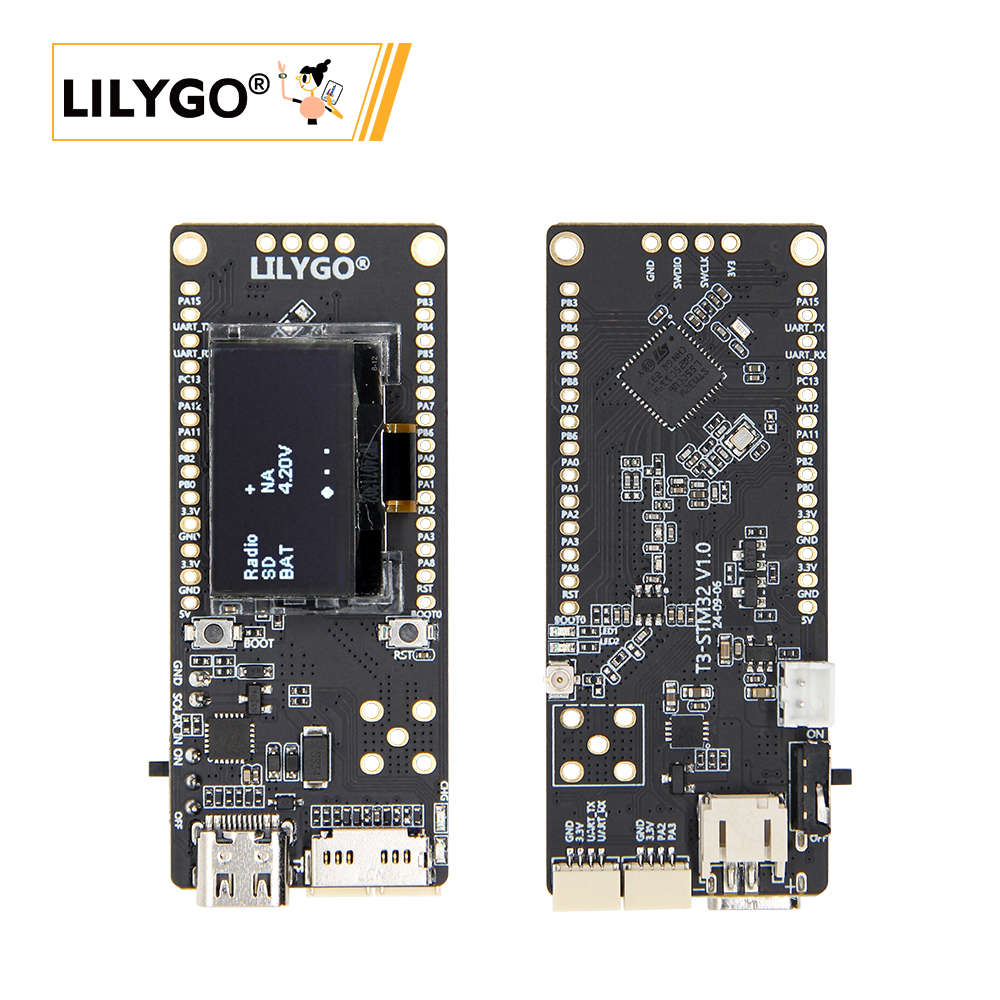
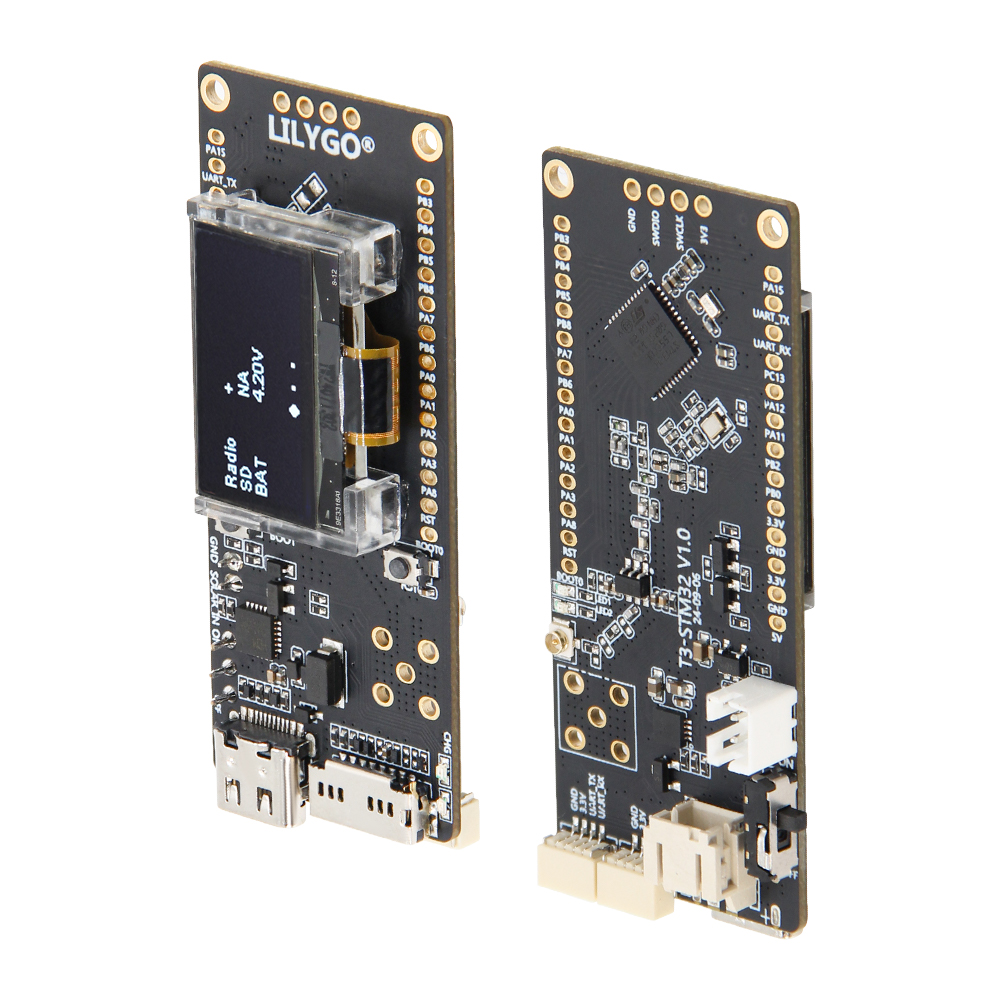
LILYGO T3-TCXO is a wireless communication development board based on the ESP32-Pico-D4 and SX1276 LoRa (868/915 MHz). The key differentiator is the onboard TCXO (Temperature Compensated Crystal Oscillator), which significantly improves frequency stability across wide temperature ranges (±0.5 ppm, −40 °C to +85 °C) — ideal for applications in environments with large temperature variations. Supports USB-C, 3.7 V Li-Po battery, and solar input. Equipped with an SSD1306 OLED and TF card slot. Suitable for smart agriculture, remote sensors, and industrial monitoring.
Quick Start
Example Support
| Example | PlatformIO/Arduino | ESP-IDF | Description |
|---|---|---|---|
| LilyGo-LoRa-Series | ✓ | LoRa, OLED, LoRaWAN, battery examples |
PlatformIO
- Install Visual Studio Code and Python
- Search for and install the PlatformIO IDE extension in VS Code
- Open the
LilyGo-LoRa-Seriesproject folder - Open
platformio.ini, under[platformio]→default_envsuncomment your board name - Click ✓ to compile, connect via USB-C, click → to upload
Arduino
- Install Arduino IDE
- Install Arduino ESP32
- Copy all folders from the
libdirectory to your Arduino libraries folder:- Windows:
C:\Users\{Username}\Documents\Arduino - macOS:
/Users/{Username}/Documents/Arduino - Linux:
/home/{Username}/Arduino
- Windows:
- Open the example
.inofile from theexamplesdirectory - In Tools → Board, configure:
| Arduino IDE Setting | Value |
|---|---|
| Board | ESP32 Dev Module |
| Port | Your port |
| CPU Frequency | 240 MHz (WiFi/BT) |
| Core Debug Level | None |
| Erase All Flash Before Sketch Upload | Disable |
| Events Run On | Core1 |
| Flash Frequency | 80 MHz |
| Flash Mode | QIO |
| Flash Size | 4MB (32Mb) |
| JTAG Adapter | Disabled |
| Arduino Runs On | Core1 |
| Partition Scheme | Huge APP (3MB No OTA/1MB SPIFFS) |
| PSRAM | Enable |
| Upload Speed | 921600 |
| Programmer | Esptool |
- In
utilities.h, uncomment your board model (e.g.,T3_V3_0_SX1276_TCXO) - Click Upload
If upload fails: hold BOOT, press and release RST, then click Upload.
Development Platforms
Video
Key Features
- ESP32-Pico-D4 dual-core @ 240 MHz, Wi-Fi + Bluetooth 4.2 + BLE
- SX1276 LoRa (868/915 MHz) with TCXO (±0.5 ppm, −40 °C to +85 °C)
- 0.96-inch SSD1306 I2C OLED
- 4 MB Flash + 2 MB PSRAM + TF card slot
- USB-C / 3.7 V Li-Po battery / solar input
- 2 × QWIIC, 2.54mm 2×13 GPIO expansion
Product Parameters
| Feature | Specification |
|---|---|
| MCU | ESP32-Pico-D4 @ Dual-core, 240 MHz |
| Flash | 4 MB |
| PSRAM | 2 MB |
| Wi-Fi | 2.4 GHz 802.11 b/g/n |
| Bluetooth | Bluetooth 4.2 + BLE |
| LoRa | SX1276, 868 / 915 MHz |
| Oscillator | TCXO (Temperature Compensated) |
| Display | 0.96-inch SSD1306 OLED, I2C |
| Storage | TF card slot |
| USB | 1 × Type-C |
| Power | USB / 3.7 V Li-Po / Solar |
| Expansion | 2 × QWIIC, 2.54mm 2×13 GPIO |
| Buttons | RESET + BOOT |
| Mounting Holes | 2 × M2 |
| Dimensions | 66 × 27 × 13 mm |
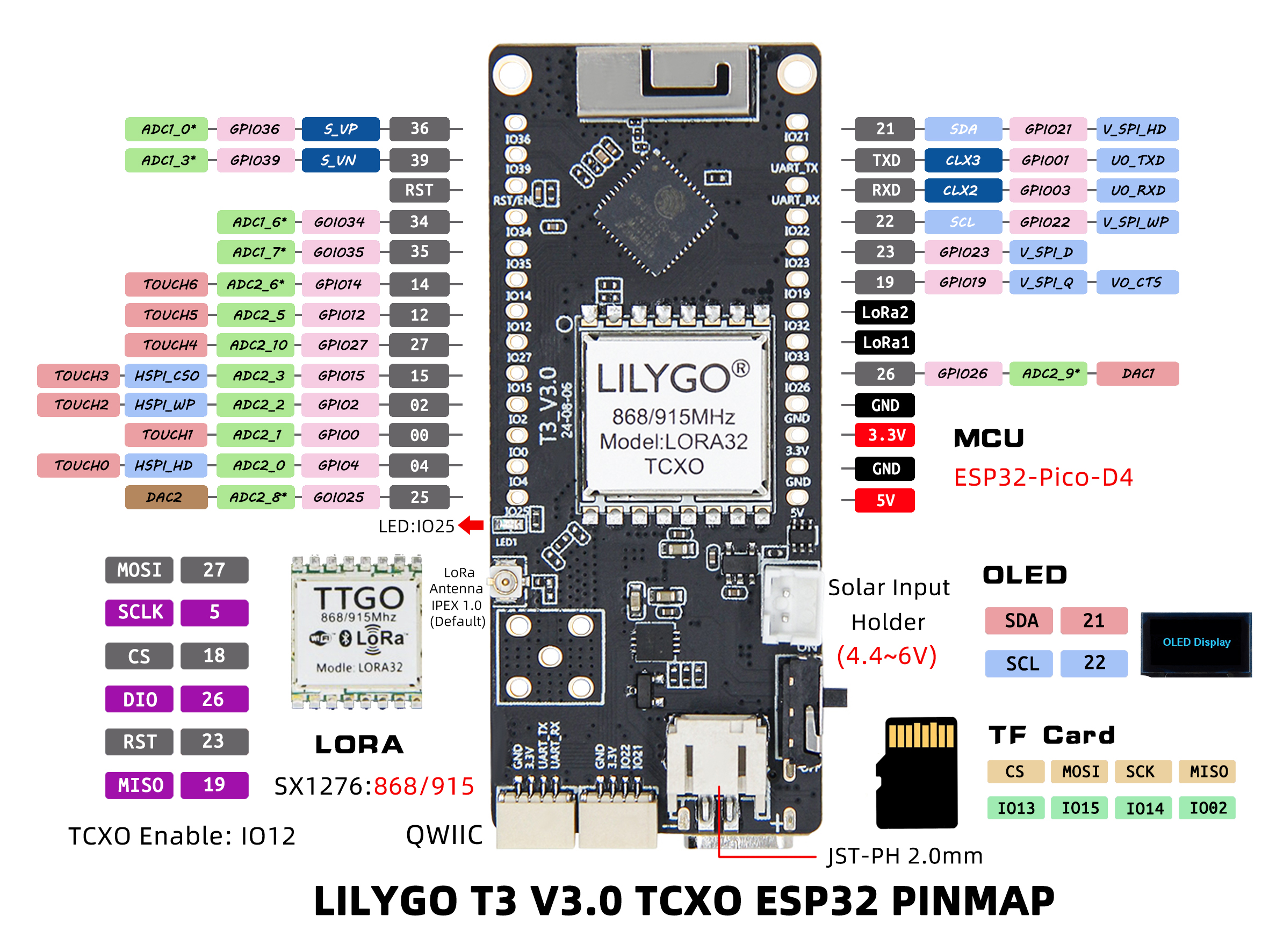
Pin Diagram
Pin Mapping
| Signal | GPIO | Available |
|---|---|---|
| OLED SDA | 21 | ❌ |
| OLED SCL | 22 | ❌ |
| SD CS | 13 | ❌ |
| SD MOSI | 15 | ❌ |
| SD MISO | 2 | ❌ |
| SD SCK | 14 | ❌ |
| LoRa SCK | 5 | ❌ |
| LoRa MISO | 19 | ❌ |
| LoRa MOSI | 27 | ❌ |
| LoRa RESET | 23 | ❌ |
| LoRa DIO0 | 26 | ❌ |
| LoRa DIO1 | 32 | ❌ |
| LoRa CS | 7 | ❌ |
| LoRa TCXO EN | 12 | ❌ |
| Battery ADC | 35 | ❌ |
| Onboard LED | 25 | ❌ |
Dimension Diagram
Schematic
Datasheet
Software Development
Dependent Libraries
FAQ
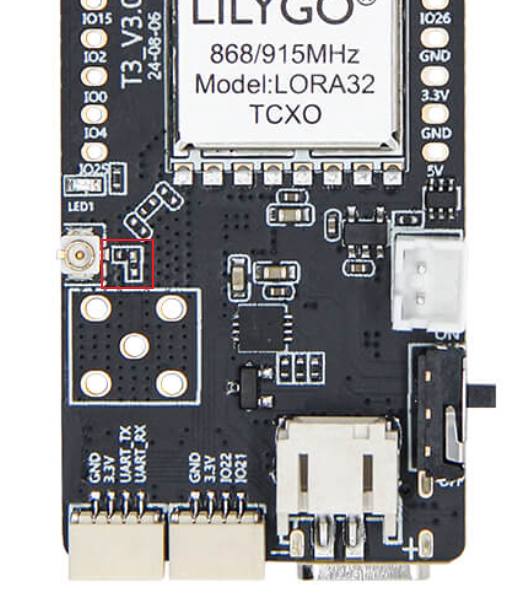
Q. How to adjust the external antenna resistor? A. Refer to the image below for resistor direction adjustment:
Q. What advantages does TCXO have over a standard crystal? A. TCXO maintains higher frequency stability when temperature changes (±0.5 ppm over −40 °C to +85 °C), suitable for precision communication in variable-temperature environments.
Q. What power supply methods are supported? A. Supports USB Type-C, 3.7 V Li-Po battery, and solar input, switchable via battery switch.
Q. What is the LoRa communication distance? A. Under ideal conditions, several kilometers. Actual range depends on environment and antenna configuration.
Q. Upload fails? A. Hold BOOT, press and release RST, then click Upload.
Version History
| Version | Release Date | Update Description |
|---|---|---|
| T3-TCXO V3.0 | — | Initial version |
Related Tests
TCXO Performance
| Temperature Range | Frequency Stability |
|---|---|
| −40 °C to +85 °C | ±0.5 ppm |
| 25 °C | ±0.2 ppm |
SX1276 RF Specifications
| Feature | Details |
|---|---|
| RF Module | SX1276 |
| Frequency Range | 840–945 MHz |
| Transfer Rate (LoRa) | 0.018–37.5 kbps |
| Transfer Rate (FSK) | 1.2–300 kbps |
| Modulation | FSK, GFSK, MSK, GMSK, LoRa, OOK |