
T-SIM7600X get it now
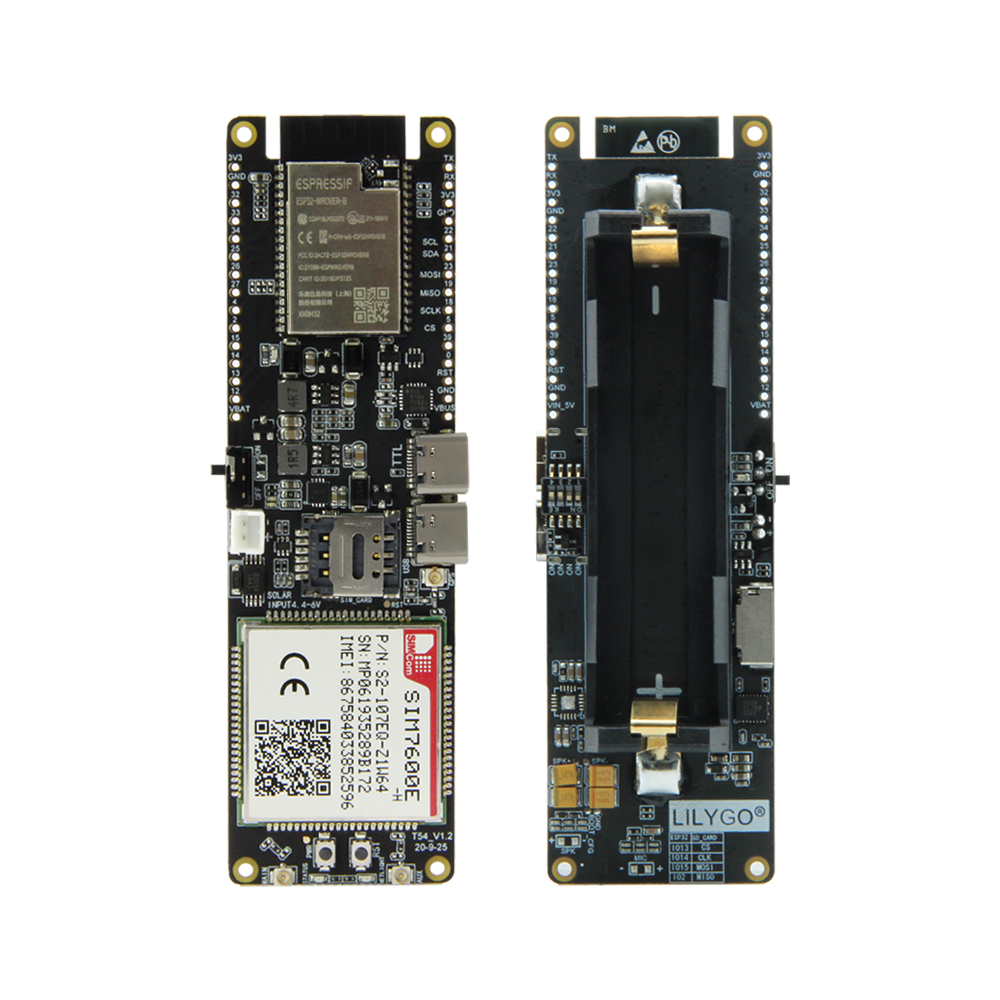
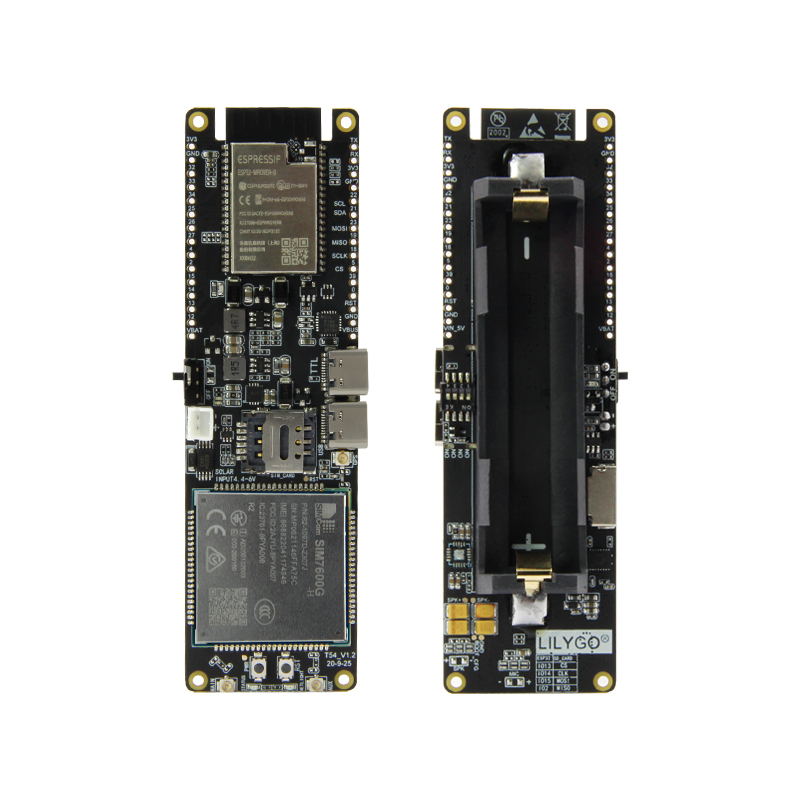
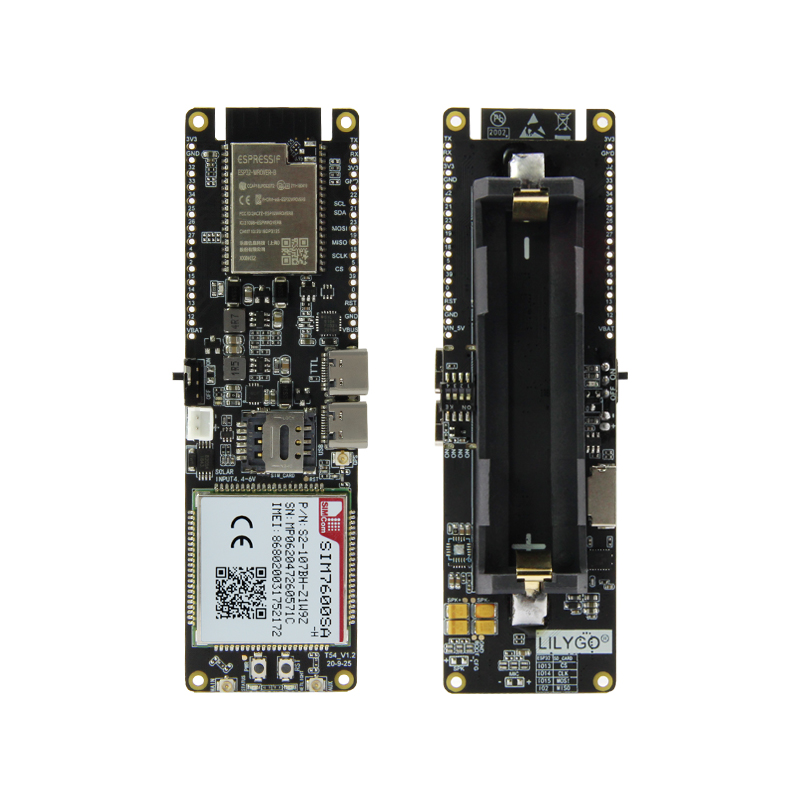
Overview
T-SIM7600X is a 4G LTE Cat-4 IoT development board based on ESP32-WROVER-B (N4R8: 4 MB Flash, 8 MB PSRAM) and the SIM7600 series cellular module. All variants share the same PCB design — the only difference is the modem chip, which determines the supported regional frequency bands. Features Nano SIM slot, TF card, 18650 battery support, and 2 × 16-pin 2.54 mm IO expansion. 111 × 34 × 19 mm.
Variant Comparison
| Variant | Modem | Region | LTE-FDD | LTE-TDD | GSM |
|---|---|---|---|---|---|
| T-SIM7600E | SIM7600E | Europe / Middle East / Africa / South Korea / Thailand | B1/B3/B5/B8/B20 | — | 900/1800 MHz |
| T-SIM7600G | SIM7600G | Global | B1/B2/B3/B4/B5/B7/B8/B12/B13/B18/B19/B20/B25/B26/B28/B66 | B34/B38/B39/B40/B41 | 850/900/1800/1900 MHz |
| T-SIM7600SA-H | SIM7600SA-H | South America / Australia / New Zealand | B1/B2/B3/B4/B5/B7/B8/B28 | — | 850/900/1800/1900 MHz |
Quick Start
Example Support
| Example | PlatformIO/Arduino | ESP-IDF | Description |
|---|---|---|---|
| LilyGo-Modem-Series | ✓ | LTE, GPS, AT command examples |
PlatformIO
- Install Visual Studio Code and Python
- Search for and install the PlatformIO IDE extension in VS Code
- Clone the LilyGo-Modem-Series repository
- Open
platformio.ini, uncommentdefault_envs = T-SIM7600Xand the desiredsrc_dirline - Click ✓ to compile, click → to upload
Arduino
- Install Arduino IDE
- Add ESP32 boards URL:
https://raw.githubusercontent.com/espressif/arduino-esp32/gh-pages/package_esp32_index.json - In Tools → Board, configure:
| Arduino IDE Setting | Value |
|---|---|
| Board | ESP32 Dev Module |
| Upload Speed | 921600 |
| CPU Frequency | 240 MHz (WiFi/BT) |
| Flash Frequency | 80 MHz |
| Flash Mode | QIO |
| Flash Size | 4MB (32Mb) |
| Partition Scheme | Huge APP (3MB No OTA/1MB SPIFFS) |
| PSRAM | Enabled |
| Core Debug Level | None |
- Click Upload
Note: Do not update libraries when prompted in Arduino IDE — updated versions may break compatibility (e.g. TinyGSM).
Development Platforms
Related Videos
Key Features
- ESP32-WROVER-B (N4R8) @ 240 MHz, 4 MB Flash, 8 MB PSRAM, Wi-Fi + BT 4.2
- SIM7600X LTE Cat-4, max 150 Mbps downlink / 50 Mbps uplink
- Integrated multi-constellation GNSS
- Nano SIM, TF card, 18650 battery, 2 × 16-pin 2.54 mm expansion
Product Parameters
| Feature | Specification |
|---|---|
| MCU | ESP32-WROVER-B (N4R8), dual-core LX6 @ 240 MHz |
| Flash | 4 MB |
| PSRAM | 8 MB |
| Wi-Fi | 2.4 GHz 802.11 b/g/n |
| Bluetooth | BT 4.2 |
| Cellular | SIM7600X LTE Cat-4 (variant dependent) |
| Max Downlink | 150 Mbps |
| Max Uplink | 50 Mbps |
| GNSS | Multi-constellation |
| SIM | Nano SIM |
| Storage | TF card, 18650 battery holder |
| USB | 1 × Type-C |
| Expansion | 2 × 16-pin 2.54 mm IO |
| Mounting Holes | 4 × 2 mm |
| Dimensions | 111 × 34 × 19 mm |
Pin Diagram
| Function | GPIO |
|---|---|
| Modem TX | 27 |
| Modem RX | 26 |
| Modem PWRKEY | 4 |
| Modem RING | 33 |
| Modem DTR | 32 |
| Modem Flight Mode | 25 |
| Modem Status | 34 |
| Board LED | 12 |
| SD SCK | 14 |
| SD MISO | 2 |
| SD MOSI | 15 |
| SD CS | 13 |
| Battery ADC | 35 |
| Solar ADC | 36 |
| Default SDA | 21 |
| Default SCL | 22 |
⚠️ Do not connect any wires to GPIO4, GPIO25, GPIO32, or GPIO33 header positions — these are reserved for modem functions.
Dimension Diagram
Schematic
Datasheet
Software Development
Dependent Libraries
FAQ
Q. Why does my board fail to upload? A. Hold down the BOOT button and try uploading again.
Q. What is the difference between T-SIM7600E / G / SA-H? A. The PCB and firmware are identical. The only difference is the modem chip, which determines the supported frequency bands and regions — choose the variant that matches your deployment region.
Q. Does T-SIM7600X support GPS? A. Yes — SIM7600 integrates multi-constellation GNSS. Connect an active GPS antenna to the GNSS connector.
Q. SIM card not detected. A. Insert the SIM card before powering on. Hot-inserting may cause detection failure.
Version History
| Version | Release Date | Update Description |
|---|---|---|
| V1.0 | — | Initial version |