
T-SIMCam get it now
Overview
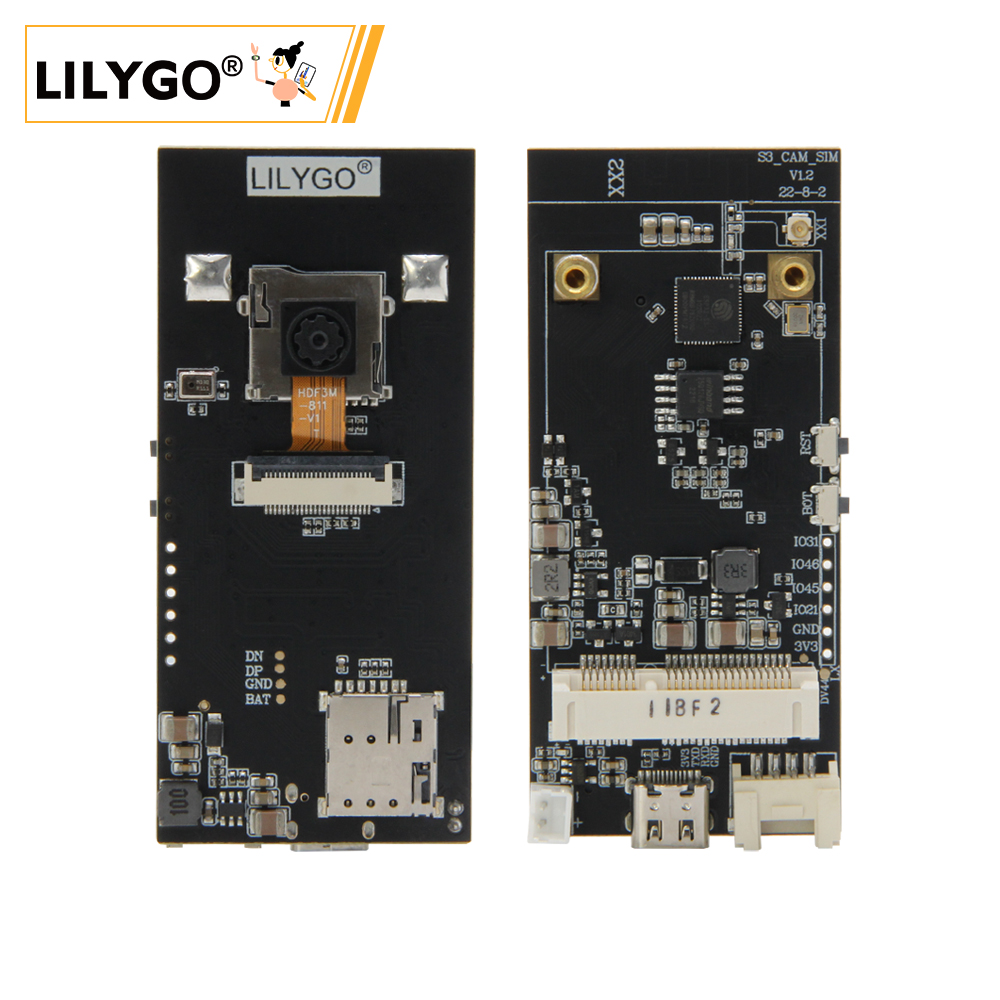
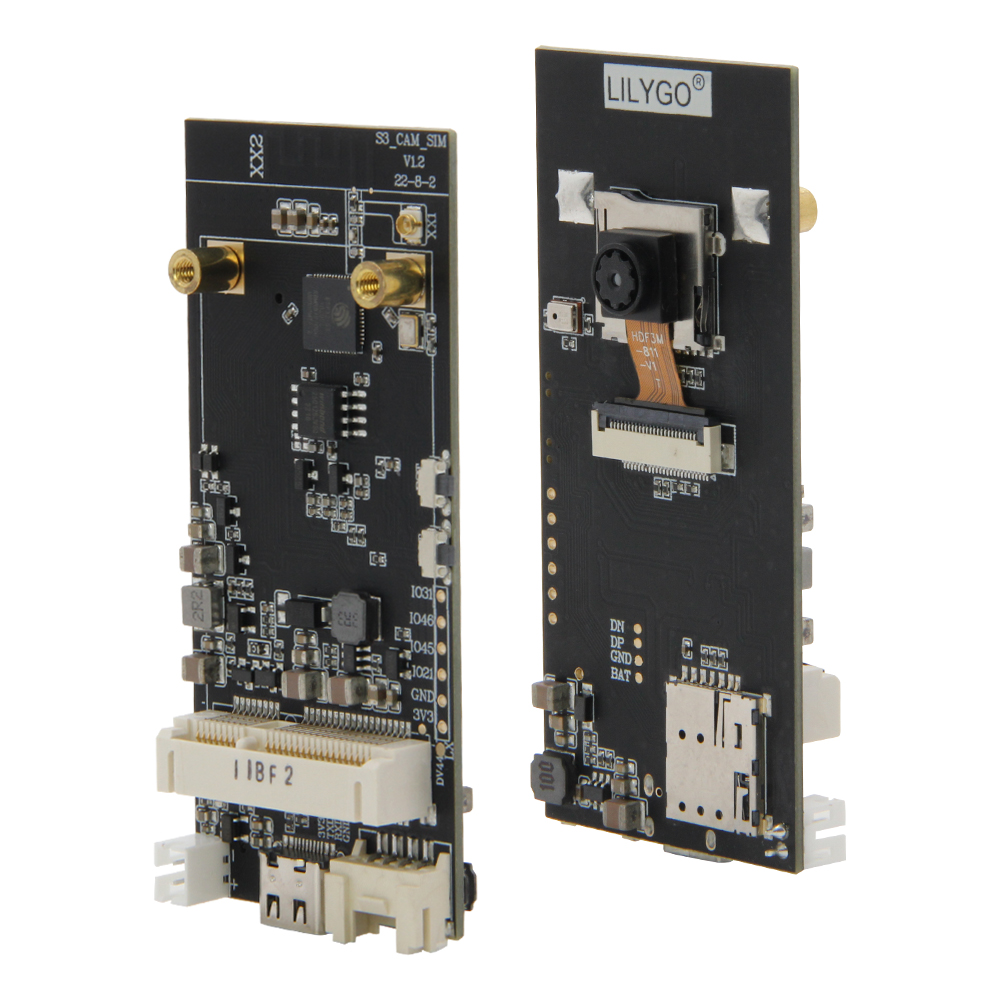
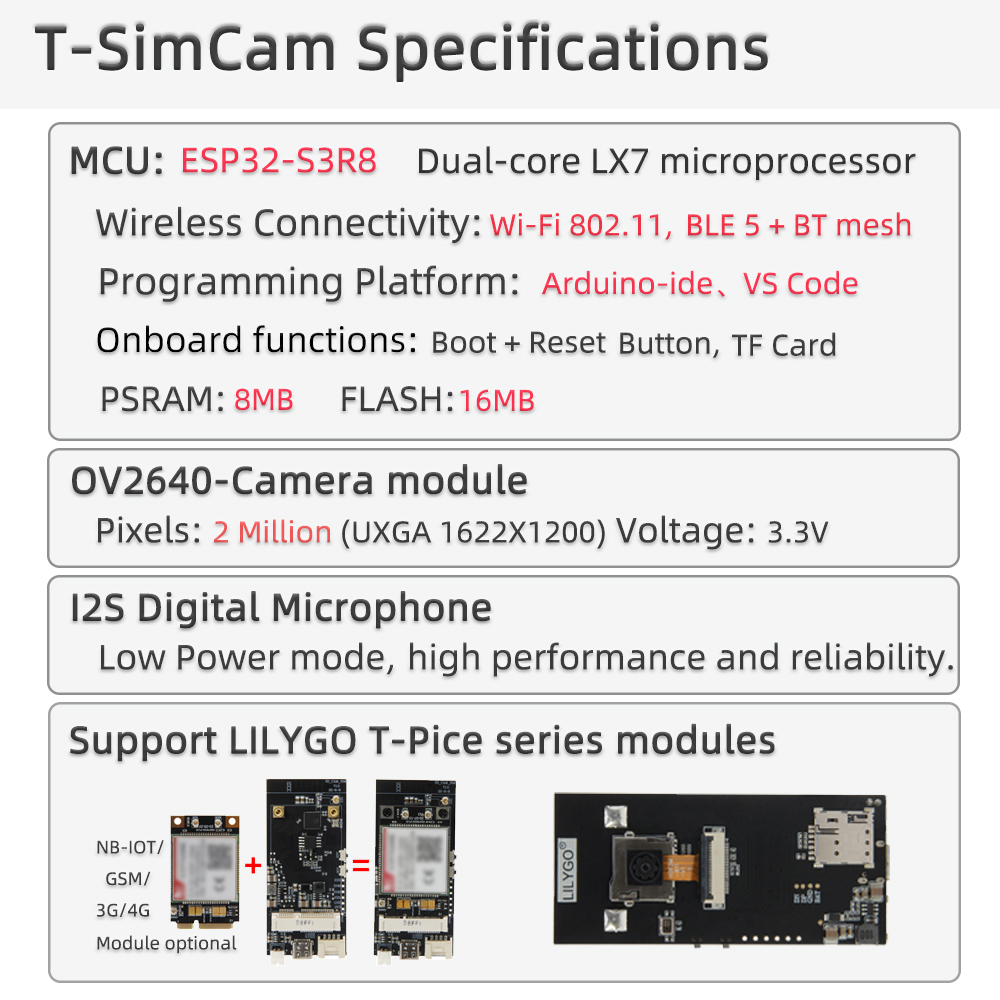
LILYGO T-SIMCam is an all-in-one ESP32-S3 camera and cellular IoT board combining an OV2640 2MP camera with a Mini PCIe (mPCIe) cellular modem slot. Powered by the ESP32-S3 dual-core LX7 @ 240 MHz with Wi-Fi and Bluetooth 5.0, it supports LTE/4G cellular modules in mPCIe form factor (such as SIM7600X) for image capture and remote transmission over cellular networks. Features a Nano SIM card slot, I2S microphone, USB-C for power and programming, and a battery connector. Ideal for remote surveillance cameras, wildlife monitoring stations, industrial inspection cameras, and cellular-connected smart camera applications.
Quick Start
Example Support
| Example | PlatformIO/Arduino | ESP-IDF | Description |
|---|---|---|---|
| T-SIMCam | ✓ | Camera capture, cellular upload, MQTT examples |
PlatformIO
- Install Visual Studio Code and Python
- Search for and install the PlatformIO IDE extension in VS Code
- Open the
T-SIMCamproject folder - Open
platformio.iniand select your example - Click ✓ to compile, connect via USB-C, click → to upload
Arduino
- Install Arduino IDE
- Install Arduino ESP32
- In Tools → Board, configure:
| Arduino IDE Setting | Value |
|---|---|
| Board | ESP32S3 Dev Module |
| Port | Your port |
| USB CDC On Boot | Enable |
| CPU Frequency | 240 MHz (WiFi) |
| Flash Size | 16MB (128Mb) |
| Partition Scheme | 16M Flash (3MB APP/9.9MB FATFS) |
| PSRAM | OPI PSRAM |
| Upload Mode | UART0/Hardware CDC |
| Upload Speed | 921600 |
| USB Mode | CDC and JTAG |
- Click Upload
Development Platforms
Related Videos
Key Features
- ESP32-S3 dual-core LX7 @ 240 MHz, Wi-Fi + Bluetooth 5.0
- OV2640 2MP camera (JPEG output, up to 1600 × 1200)
- Mini PCIe (mPCIe) slot for cellular modem modules (SIM7600X, etc.)
- Nano SIM card slot
- I2S MEMS microphone
- USB-C for programming and power
- 3.7 V Li-Po battery connector
- 16 MB Flash, 8 MB PSRAM
Specifications
| Parameter | Value |
|---|---|
| SOC | ESP32-S3, Dual-core LX7 @ 240 MHz |
| Flash | 16 MB |
| PSRAM | 8 MB |
| Wireless | Wi-Fi 802.11 b/g/n, Bluetooth 5.0 |
| Cellular | Via mPCIe module (e.g. SIM7600X) |
| Camera | OV2640, 2MP, up to 1600 × 1200 |
| Microphone | I2S MEMS |
| SIM | Nano SIM |
| USB | 1 × USB-C |
| Battery | 3.7 V Li-Po connector |
Pin Diagram
Camera (OV2640, DVP)
| Signal | GPIO |
|---|---|
| HREF | 26 |
| VSYNC | 25 |
| PCLK | 36 |
| XCLK | 40 |
| D0–D7 | 39, 41, 42, 43, 44, 45, 46, 48 |
| SDA (SCCB) | 4 |
| SCL (SCCB) | 5 |
| PWDN | 9 |
| RESET | 8 |
Modem UART
| Signal | GPIO |
|---|---|
| UART TX (to modem) | 18 |
| UART RX (from modem) | 17 |
| PWR KEY | 10 |
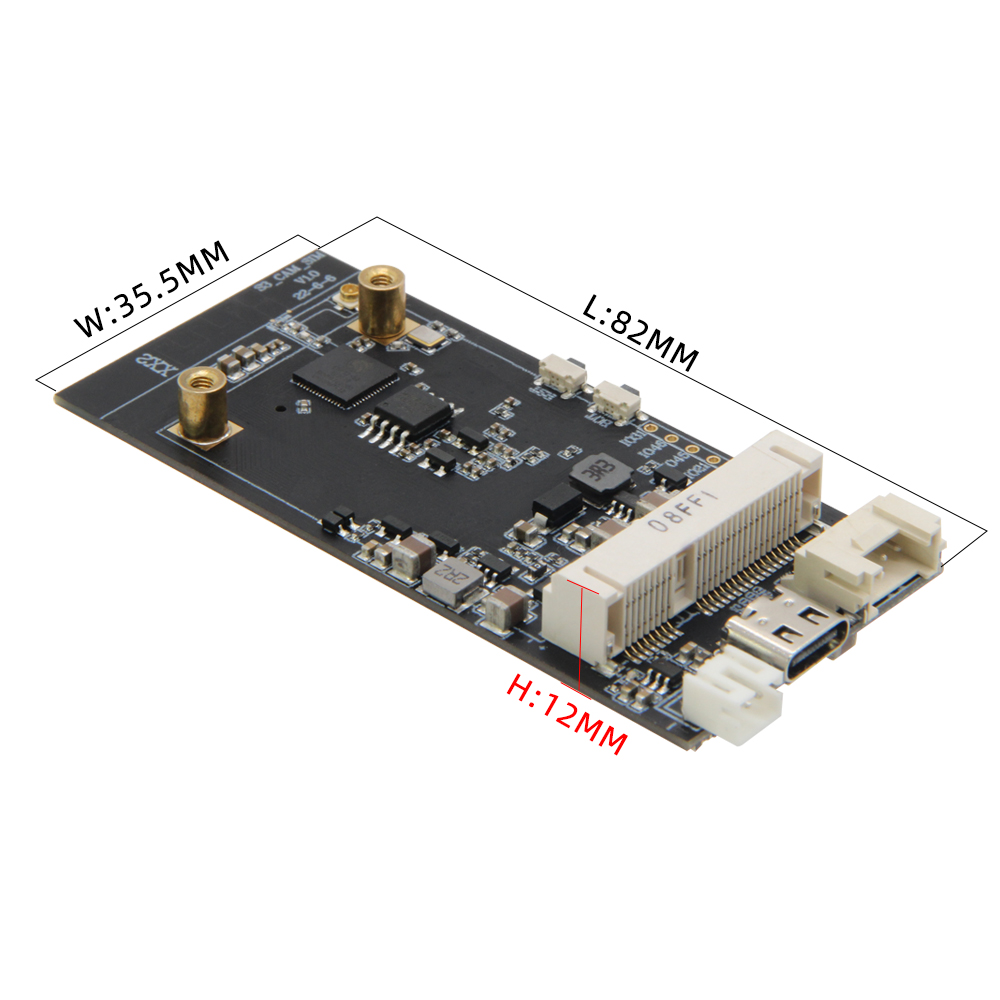
Dimensions
Schematic
Datasheet
Software Libraries
Dependent Libraries
FAQ
Q. Which cellular modules are compatible with T-SIMCam? A. The mPCIe slot is designed for SIM7600X-series LTE Cat-4 modules. Other standard mPCIe cellular modules may work; verify UART pin compatibility and power requirements.
Q. What image resolutions does the OV2640 support? A. The OV2640 supports resolutions from QQVGA (160 × 120) up to UXGA (1600 × 1200) in JPEG mode. Typical streaming resolutions are VGA (640 × 480) or SVGA (800 × 600) for balance between quality and frame rate.
Q. Can I stream live video over 4G? A. Live MJPEG streaming over LTE is possible with sufficient network bandwidth. Compress JPEG frames and use an MQTT or HTTP server to relay images. Full H.264 video streaming requires an external video encoder not available on the OV2640.
Changelog
| Version | Date | Notes |
|---|---|---|
| V1.0 | Initial release |