T-Display Bar get it now
Overview
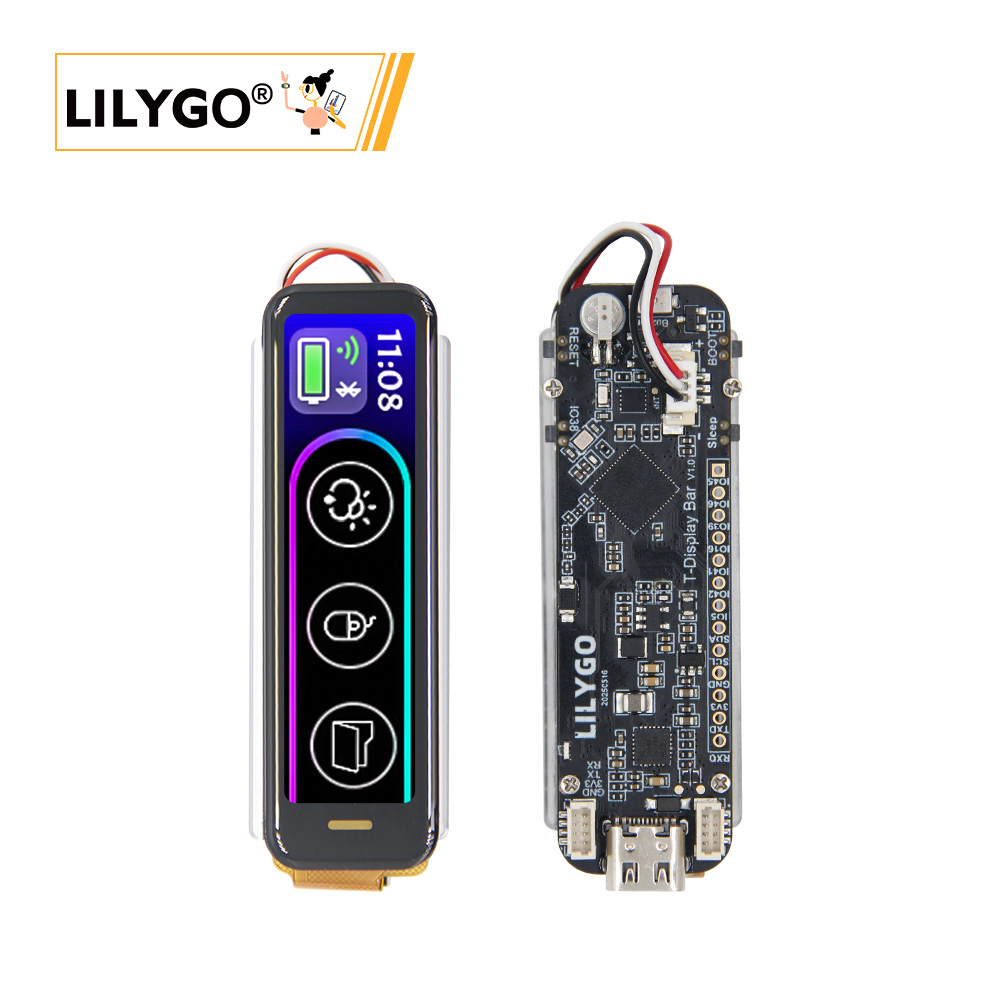
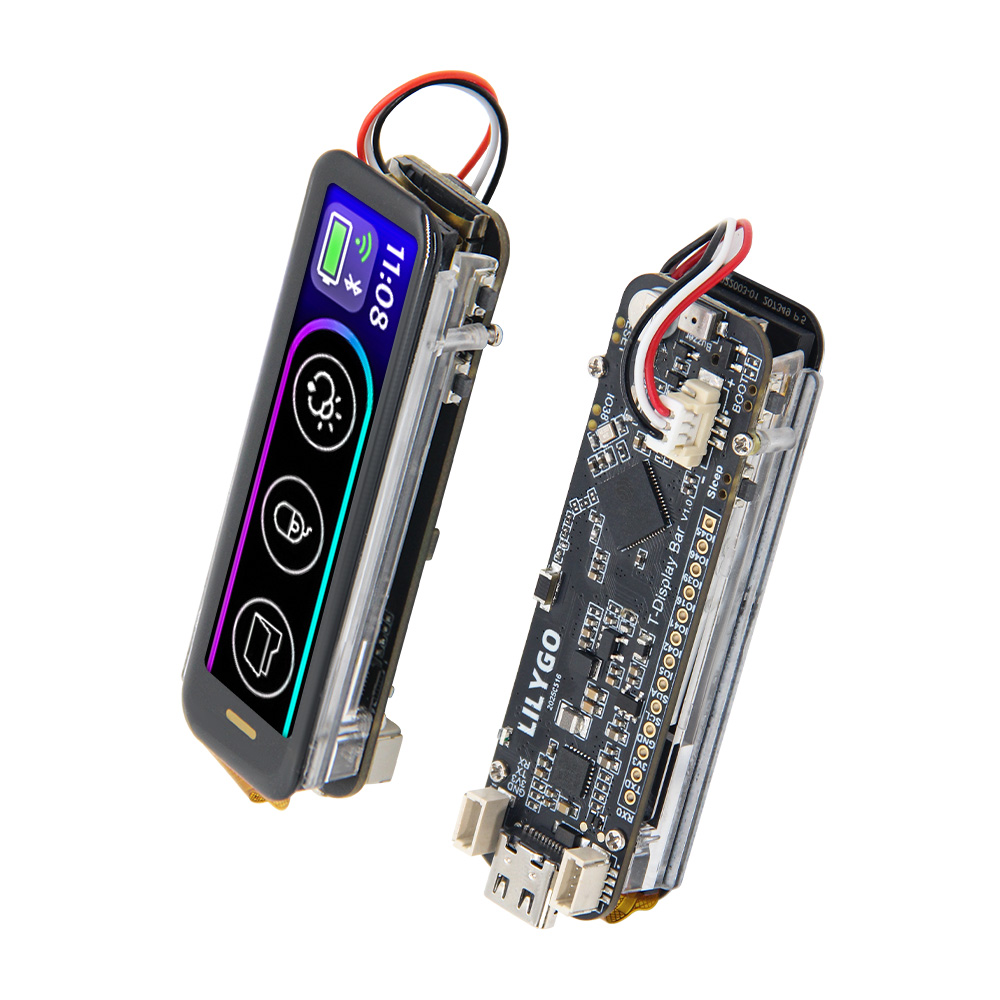
LILYGO T-Display Bar is a highly integrated embedded smart display module based on ESP32-S3-R8 (16 MB Flash, 8 MB OPI PSRAM). Features a 2.25-inch ST7789 IPS LCD (76 × 284) with CST816 capacitive touch, BHI260AP AI six-axis IMU (accelerometer + gyroscope), active buzzer, TF card slot, and 2 × QWIIC interfaces. Compact design (69 × 23 × 15 mm) suitable for both industrial deployment and portable devices.
Quick Start
Example Support
| Example | PlatformIO/Arduino | ESP-IDF | Description |
|---|---|---|---|
| T-Display-Bar | ✓ | Display, IMU, BQ27220, RTC, sleep examples |
PlatformIO
- Install Visual Studio Code and Python
- Search for and install the PlatformIO IDE extension in VS Code
- Open the
T-Display-Barproject folder - Open
platformio.iniand select your example - Click ✓ to compile, connect via USB-C, click → to upload
Arduino
- Install Arduino IDE
- Install Arduino ESP32
- In Tools → Board, configure:
| Arduino IDE Setting | Value |
|---|---|
| Board | ESP32S3 Dev Module |
| Port | Your port |
| USB CDC On Boot | Enable |
| CPU Frequency | 240 MHz (WiFi) |
| Core Debug Level | None |
| USB DFU On Boot | Disable |
| Erase All Flash Before Sketch Upload | Disable |
| Events Run On | Core1 |
| Flash Mode | QIO 80 MHz |
| Flash Size | 16MB (128Mb) |
| Arduino Runs On | Core1 |
| USB Firmware MSC On Boot | Disable |
| Partition Scheme | 8M with spiffs (3M APP/1.5MB SPIFFS) |
| PSRAM | OPI PSRAM |
| Upload Mode | UART0/Hardware CDC |
| Upload Speed | 921600 |
| USB Mode | CDC and JTAG |
- Click Upload
Development Platforms
Video
Key Features
- ESP32-S3-R8 dual-core LX7 @ 240 MHz, Wi-Fi + Bluetooth 5.0
- 2.25-inch ST7789 IPS LCD (76 × 284), CST816 capacitive touch
- BHI260AP AI six-axis IMU (accelerometer + gyroscope)
- Active buzzer, TF card slot, 2 × QWIIC interfaces
- 2.54 mm 13-pin header, JST battery connector
- 69 × 23 × 15 mm
Product Parameters
| Feature | Specification |
|---|---|
| MCU | ESP32-S3-R8 @ Dual-core LX7, 240 MHz |
| Flash | 16 MB |
| PSRAM | 8 MB (OPI PSRAM) |
| Wi-Fi | 2.4 GHz 802.11 b/g/n |
| Bluetooth | Bluetooth 5.0 LE |
| Display | 2.25-inch ST7789 IPS LCD, 76 × 284 |
| Touch | CST816 capacitive, I²C |
| Sensor | BHI260AP six-axis IMU (AI sensor) |
| Buzzer | Active buzzer |
| Storage | TF card slot |
| USB | 1 × Type-C (USB + OTG) |
| Expansion | 2 × QWIIC + 2.54 mm 13-pin header + JST battery |
| Buttons | RST + BOOT + IO38 + Sleep |
| Dimensions | 69 × 23 × 15 mm |
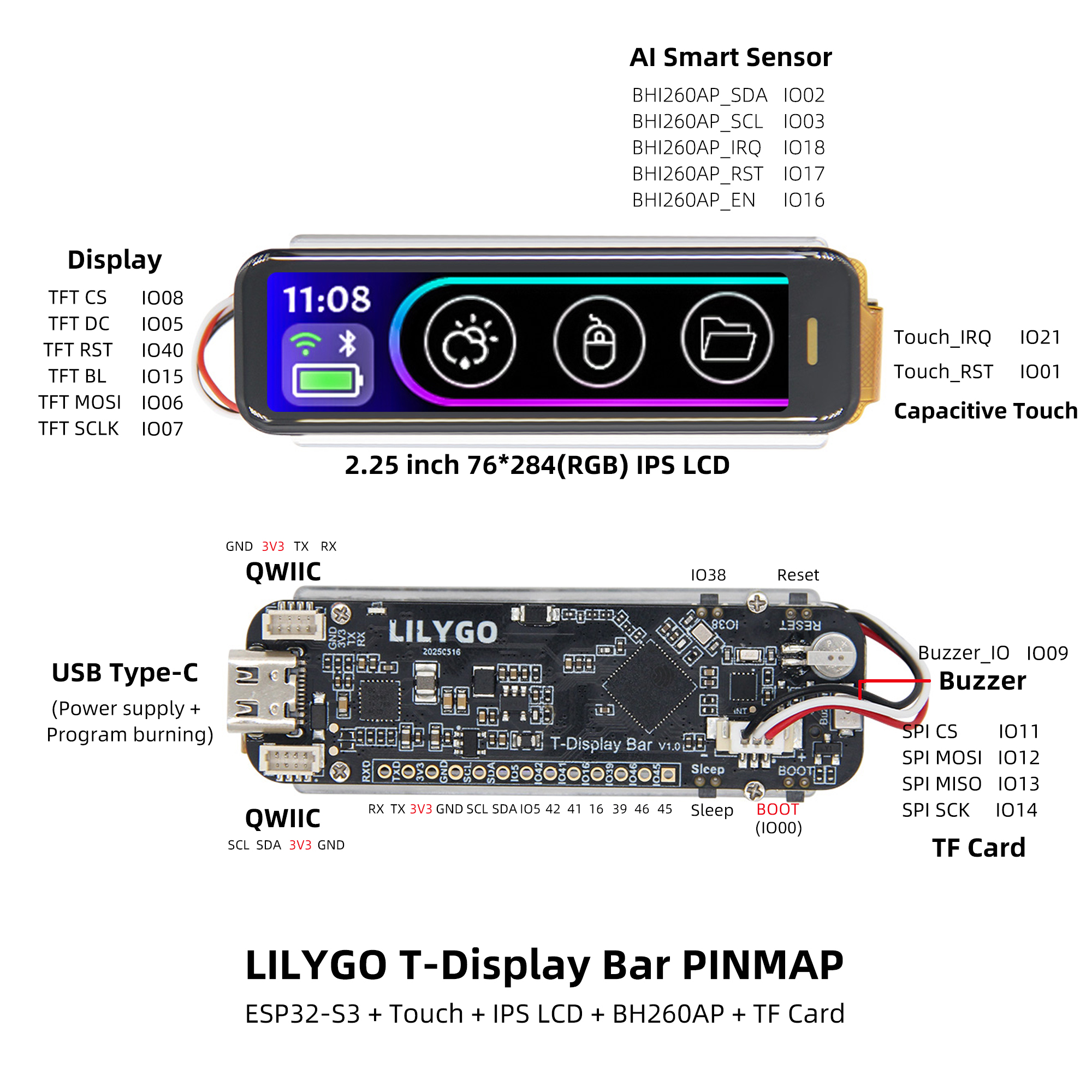
Pin Diagram
Pin Mapping
| TFT (SPI) | IO6 (MOSI), IO7 (SCLK), IO8 (CS), IO5 (DC), IO40 (RST), IO15 (BL) |
|---|---|
| Touch (CST816) | IO2/IO3 (SDA/SCL), IO21 (IRQ), IO1 (RST) |
| BHI260AP | IO2/IO3 (SDA/SCL), IO18 (IRQ), IO17 (RST), IO16 (EN) |
| SD (SPI) | IO12 (MOSI), IO13 (MISO), IO14 (SCK), IO11 (CS) |
| Buzzer | IO9 |
| Buttons | IO38 (Button1), IO0 (Button2/BOOT) |
Dimension Diagram
Schematic
Datasheet
Software Development
Dependent Libraries
FAQ
Q. Why does my board keep failing to upload programs? A. Hold down the BOOT button and try uploading again.
Q. Why is there no serial data output from the Uart interface? A. The project defaults to USB CDC as Uart0. Set USB CDC On Boot to Disabled in Arduino Tools, or change
-DARDUINO_USB_CDC_ON_BOOT=truetofalseinplatformio.ini.
Version History
| Version | Release Date | Update Description |
|---|---|---|
| T-Display Bar V1.1 | — | Initial version |